

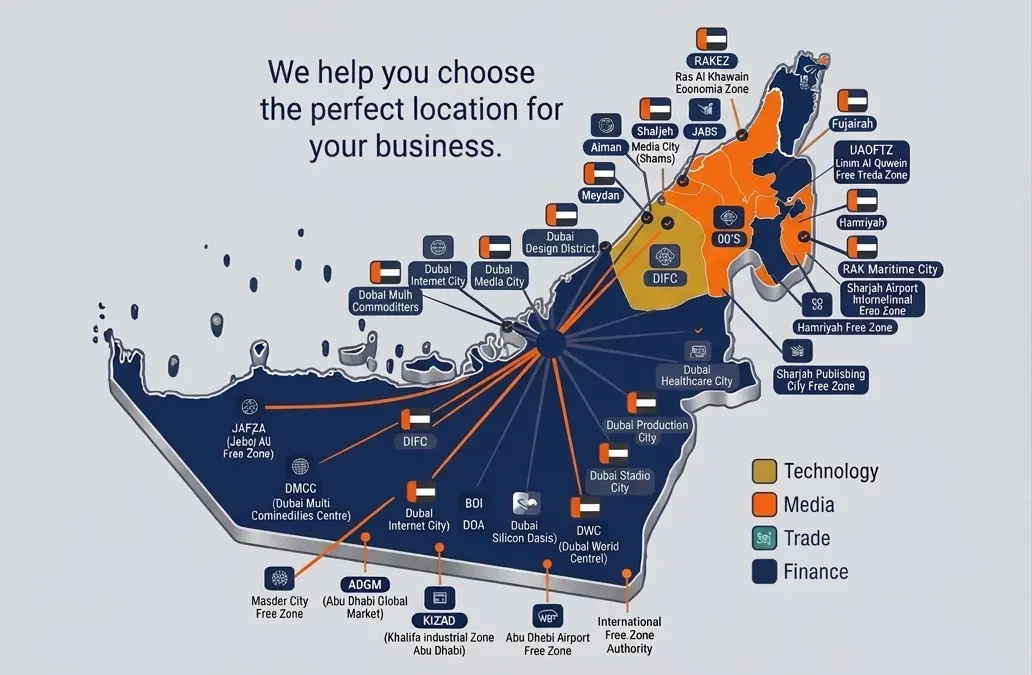
We help you choose the perfect location for your business.
Setting up your business in the UAE free zones helps you get many incentives, like tax-free exemptions, no duty obligations, 100% foreign ownership, and simplified administrative processes in designated economic areas in the UAE.
The benefits are incredible; you can regulate your business under your own rules while getting economic benefits, growth, high-end infrastructure, and foreign investment.
Now the question arises, which industries can set up their businesses in the UAE free zones? And surprisingly, almost all industries can get this benefit over any other country.
A UAE Free Zone is a designated economic area where businesses enjoy special incentives and regulations designed to attract foreign investment. Companies established in free zones can benefit from 100% foreign ownership, tax exemptions, quick licensing, and straight customs procedures.
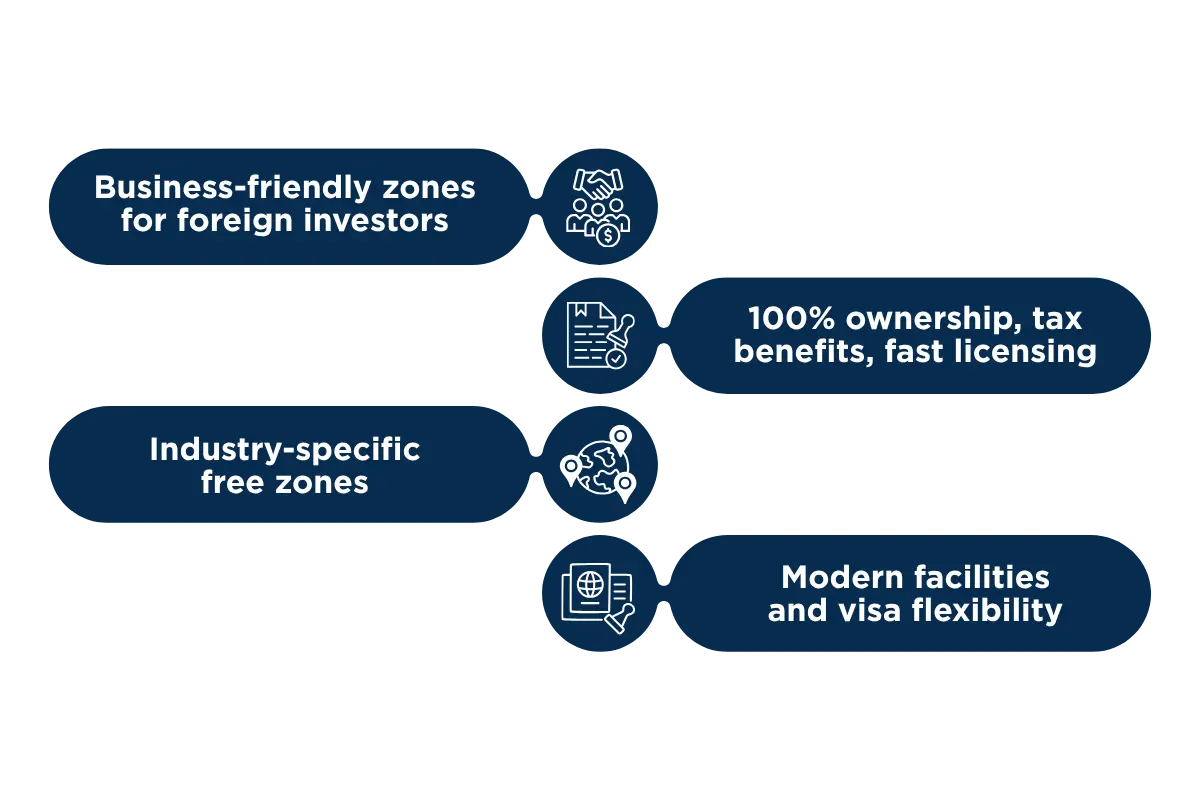
Each free zone is designed for specific industries, such as trade, logistics, media, or finance, and provides modern infrastructure, office spaces, banking facilities, and visa flexibility, making it easier for entrepreneurs and investors to set up and operate in the UAE.
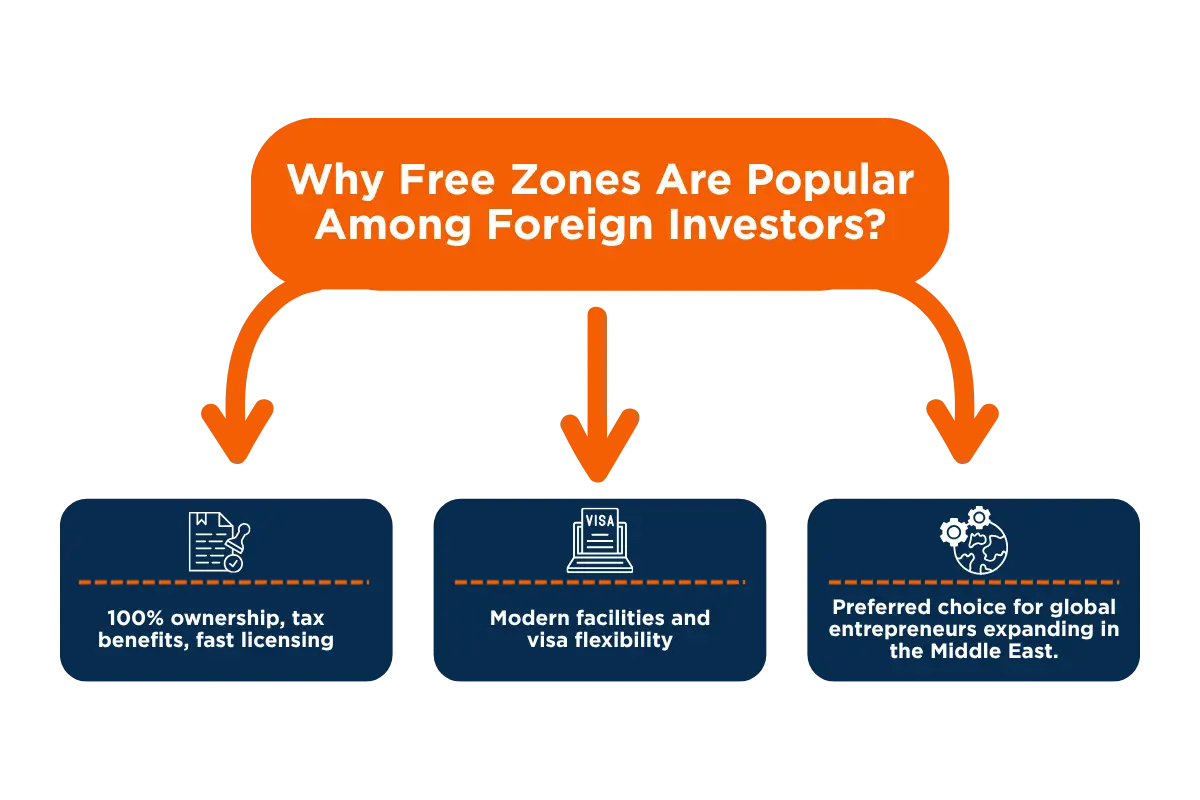
Free zones in the UAE are popular among foreign investors because they offer higher financial benefits, including 100% ownership, tax exemptions, easy repatriation of profits, and fast company setup in the UAE compared to many other jurisdictions.
These zones also provide modern infrastructure, visa support, and simplified regulations for banking or office leasing, making them a top choice for global entrepreneurs seeking growth in the Middle East.
Mainland companies are licensed to operate anywhere in the UAE and can trade directly with the local market, but often require a local partner.
Offshore companies are mainly used for holding assets or international trading; they cannot conduct business within the UAE market.
Free zone companies offer 100% foreign ownership, tax benefits, and sector-specific facilities but are limited to operating within their zone or internationally unless they partner with a mainland distributor.
When setting up in a UAE free zone, businesses can choose from three main structures depending on the number of shareholders and the nature of the business. Each structure offers different levels of ownership, liability, and operational flexibility.
FZE and FZC offer limited liability and 100% foreign ownership, giving investors strong protection and independence. Branches, while flexible for expansion, do not provide liability separation since the parent company remains responsible.
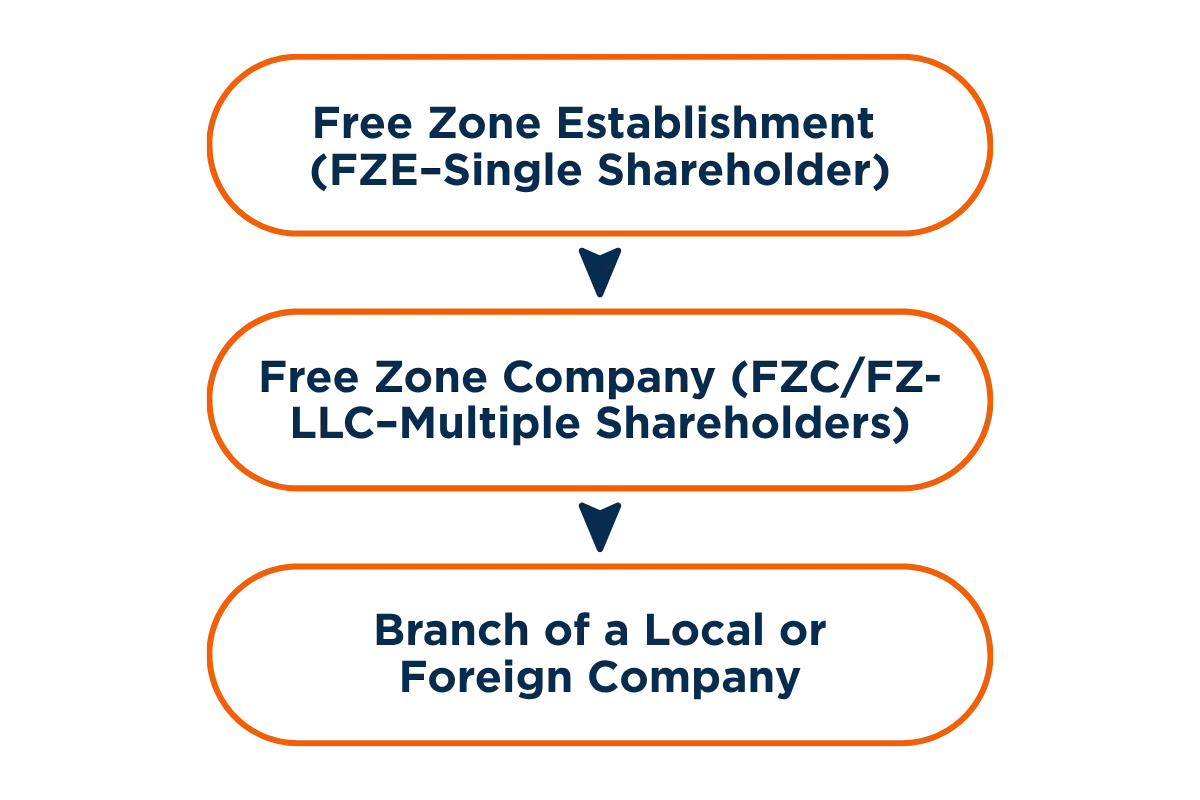
An FZE is a limited liability company with a single shareholder, either an individual or a corporate entity. It offers full foreign ownership and limited liability protection, making it ideal for solo investors.
An FZC or FZ-LLC allows two or more shareholders, either individuals or companies. This structure is suitable for partnerships and provides the same limited liability protection as an FZE.
A branch enables an existing UAE or overseas company to establish a presence in a free zone without creating a separate legal entity. It operates under the parent company’s name and bears full liability for its activities.
Allows businesses to import, export, distribute, and trade goods.
Issued to companies providing services such as consultancy, IT, or education.
Designed for online trading, digital marketplaces, and electronic services.
Tailored for specialized industries operating within dedicated free zones.
Permits light or heavy manufacturing, processing, and packaging activities.
Now you have finally decided to set up your business in the UAE, but wait, have you chosen the right UAE free zones, or need a complete guide on how to choose a UAE free zone for your business? Let’s understand the details at a glance.
At CorpLex, we help you navigate the UAE’s free zones to set up your businesses with easy market access, facilities, banking, and visa options.
Need further details? Call us now.
Here is how we proceed while setting up your business in the UAE free zones.
The first step towards setting up your business in a UAE free zone is to find the right zone, based on your activity.
Decide on the appropriate legal structure for your company.
Once decided, register your company’s trade name with supporting documents like passport copies.
After approval, you can get your business license, pay for the initial fee, complete the visa and Emirates ID process.
Secure a physical or flexi-desk office space as required by the free zone regulations.
Free zones offer a range of workspace options tailored to the scale of operations and visa needs:
Most free zones link visa quotas to the type/size of the office. Plan your hiring and contractor strategy: investor visas come first, followed by key staff and then operational hires. CorpLex will estimate visa counts, prepare documentation, and manage the application process to minimize delays.
Confirm on-site customs clearance (for logistics), access to freight and ports, and proximity to banks and service providers. If you require specialized facilities (labs, cold storage, large workshops), we help identify zones with the necessary infrastructure.
Costs vary by free zone, activity, and office choice.
If you would like, CorpLex can prepare a tailored cost estimate based on your activity, headcount plan, and preferred office type.
We prioritize compliance and regulatory clarity so your company is protected from day one.
From trade name to bank account, visas, and post-setup compliance.
We match your business model to the best zones, office types, and licensing options.
Established relationships with free zone authorities and service partners reduce delays.
We prepare KYC-ready documentation and introduce you to suitable banks.
Accounting, VAT advisory, and annual renewal management so you can focus on growth.
EXCELLENTTrustindex verifies that the original source of the review is Google. I wanted to leave this review because my experience with Corplex has truly been very rewarding. The entire process was highly professional, fast, and extremely well organized. Above all, I would like to highlight the constant support and attention to every question we had throughout the process of applying for our freelancer visa. Rana did an outstanding job. She explained everything clearly, was always available to resolve any doubts, and most importantly, made us feel that we were in very good hands. Coming from another country and not knowing anything about Dubai beforehand, this level of professionalism and reassurance is incredibly valuable. In addition, we really appreciate that Corplex offers a very comprehensive, end-to-end service. We also started the company formation process with them, and Mohammad helped us tremendously. He not only supported us with the business setup but also made us feel at home with all the advice and guidance he gave us, including during the search for a business location. Nisa also assisted us and was always very professional and attentive. The entire team is wonderful. We can only recommend Corplex 100% for any type of administrative or business-related procedures. Their service is truly exceptional.Posted onTrustindex verifies that the original source of the review is Google. We received excellent service from Complex team for our accounting and HR . The team is perfect, always very helpful and supportive.Posted onTrustindex verifies that the original source of the review is Google. Professional VIP experience ! Thank you so much team 🙏Posted onTrustindex verifies that the original source of the review is Google. Once again, I’m pleased to confirm the quality and efficiency of this company, CorpLex Corporate Services. During the increasingly complex auditing and license renewal procedures for UAE companies, I received consistent and invaluable support from the entire team. I would like to especially thank Mr. Nosir, Mrs. Janine, Mrs. Rana, and Mrs. Manar for being present, prompt, and attentive throughout the process. In situations like these, professionalism is essential, but the kindness and genuine care I experienced made all the difference. These qualities are just as important and deeply appreciated. Thank you all. Luca AngioliniPosted onTrustindex verifies that the original source of the review is Google. Very fast and efficient service! Great communication and guidance. 100% recommended.Posted onTrustindex verifies that the original source of the review is Google. The most efficient and professional company I have worked with in a really long time. They assist you every single step of the way, very professional and super efficient. From collecting me at my hotel for my appointments to ensuring that I get the desired result super fast. Friendly and understanding staff. You will not regret making use of their services.Posted onTrustindex verifies that the original source of the review is Google. Excellent work from team of Abbos and Janine , in order of corporate tax ,very professional and knowledge of a very complex subjectPosted onTrustindex verifies that the original source of the review is Google. Очень четкая, структурированная и грамотно выстроенная работаPosted onTrustindex verifies that the original source of the review is Google. Very professional and efficient team. Helped us sort out everything quickly and with no hassle. Clear communication, attention to detail, and real expertise. Great experience, would definitely recommend.Posted onTrustindex verifies that the original source of the review is Google. I have been working with CorpLex Corporate Services for nine years, and during this time I have had many opportunities to appreciate their high level of professionalism and expertise. In every circumstance, I have always been confident that I was being reliably assisted by Aziz and his colleagues, and I would like to thank them all once again. It is very important to feel at ease when working in a country that is completely different from your own. I have returned to Switzerland after ceasing my business activities, but I intend to maintain a sincere friendship with them. Once again, my heartfelt thanks to Aziz and the CorpLex Corporate Services team.
Ready to turn your business idea into a reality in the UAE? With over 40 free zones offering tax benefits, full foreign ownership, and sector-specific opportunities, now is the time to act.
At CorpLex, we don’t just process paperwork; we secure your business with legal clarity and compliance from day one. Whether you’re expanding internationally or launching your first venture, we guide you at every step. Start your free zone journey today with a team that protects your investment.
A free zone is a designated economic area with its own licensing and regulatory regime designed to attract foreign investment, typically offering tax incentives, customs benefits, and 100% foreign ownership for business activities.
Free zone companies generally need a local distributor or a mainland license to trade directly to mainland customers. There are structured mechanisms (trade license conversion or establishing a mainland branch) to access mainland markets.
Setup times vary by free zone and readiness of documents; typical timelines range from a few days for simple licenses to several weeks for full operational licenses and bank onboarding.
Some banks allow remote account opening for corporate clients, but many require in-person meetings or additional due diligence. CorpLex assists with documentation and introductions to banks that best match your profile.
Standard documents include passports and proof of address for shareholders and directors, notarized incorporation documents, a business plan or activity description, and, if applicable, signed lease agreements.
In most cases, you don’t need to visit. Many free zones allow a complete remote setup with digital signatures and couriered documents.
Yes. With proper approvals, you can shift operations from a free zone to the mainland by restructuring your license and company setup.