



Setting up a UAE offshore company looks simple on paper, yet many face rejected applications, banking hurdles, hidden costs, and regulatory penalties.
Choosing the wrong jurisdiction or incomplete paperwork creates lasting compliance risks that weaken legitimacy. In this article, we provide a clear overview of everything you should know before proceeding, including benefits, restrictions, documentation, banking considerations, and key jurisdictions like RAK, ICC, and JAFZA.
The goal is to give you a realistic picture of what a Business Setup in a UAE Offshore Company involves, before making any commitments.
To support economic diversification, the UAE has different types of entities and structures for business. One of them is offshore companies.
An Offshore Company is a legal entity registered in the UAE but designed to operate outside the country. This structure is most attractive for cross-border trade or global businesses. They provide tax optimization with low or zero corporate taxes, full foreign ownership without local sponsorship, and flexible structures for international trade.
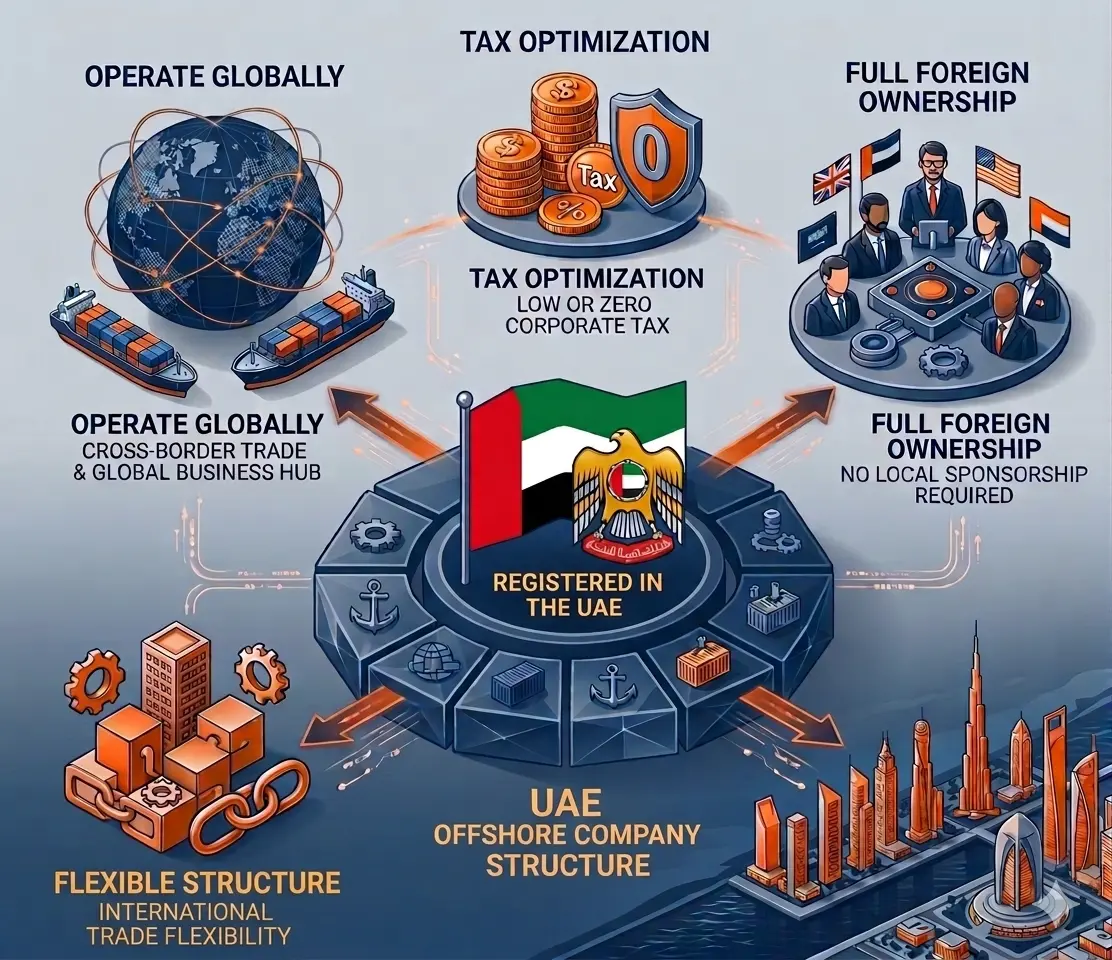
International investors prefer offshore setups for property, wealth management, and trading due to lighter regulations, stronger privacy, and simpler compliance than mainland operations.
Here’s a quick comparison to help you understand how offshore, free zone, and mainland setups compare in the UAE:
Choosing Offshore Company Registration in the UAE delivers more than tax savings.
Compared to other jurisdictions, it offers advanced telecom networks and legal certainty that many offshore destinations lack. The UAE offshore structure makes it easier to access international markets and financial networks. Incorporation is streamlined, fast, and supported by a flexible regulatory system that offers long-term business security.
For conducting international trade, including importing, exporting, and distributing goods worldwide. The license supports e-commerce and global logistics for cross-border storage, transport, and product management.
For offshore companies managing assets or investments, this license allows ownership of subsidiaries, shares, and property. It provides a framework for structured investment management while offering protection of personal and corporate assets.
License to hold, manage, and license intellectual property, including patents, trademarks, and copyrights. It provides global protection of IP assets, facilitates royalty management, and provides tax efficiency.
This license means a company can provide professional services or consultancy to clients worldwide. It covers advisory, international, and specialized services. Operate globally without requiring a physical UAE presence.
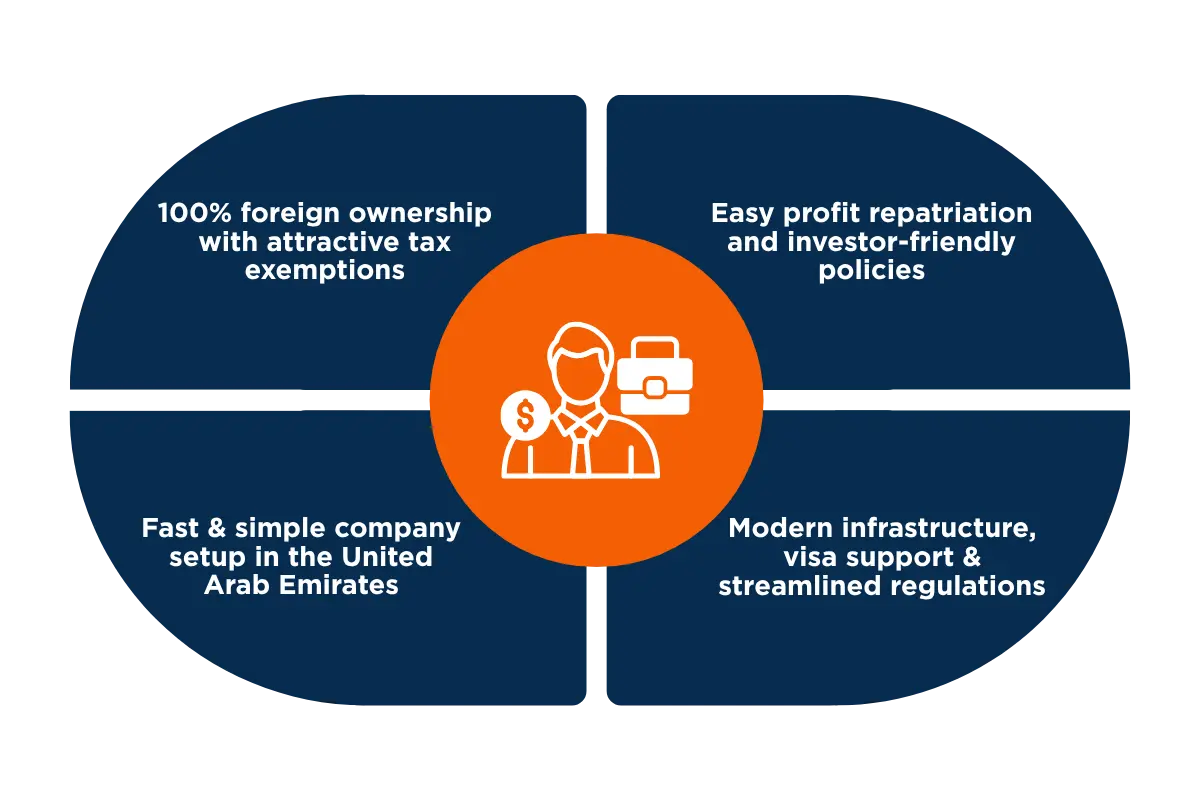
Free zones in the UAE are popular among foreign investors because they offer higher financial benefits, including 100% ownership, tax exemptions, easy repatriation of profits, and fast company setup in the UAE compared to many other jurisdictions.
These zones also provide modern infrastructure, visa support, and simplified regulations for banking or office leasing, making them a top choice for global entrepreneurs seeking growth in the Middle East.
When choosing an offshore UAE setup, you can register under different legal structures. Each type is perfect for certain business goals, offering ownership benefits, liability protection, and activity scope.
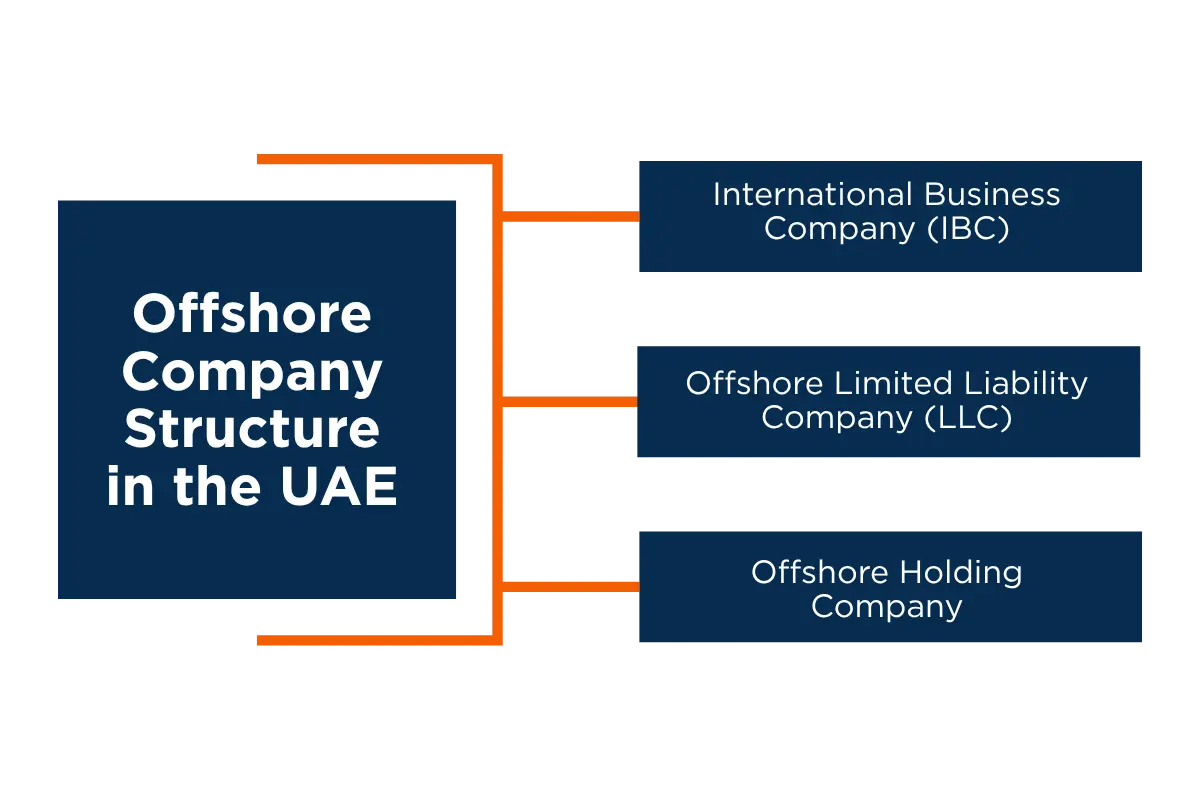
IBCs are used in the UAE for business activities outside the country. They offer 100% foreign ownership, but there’s limited liability to protect personal assets. IBCs are registered in Ras Al Khaimah or Jebel Ali. Their main purpose is international trade, wealth management, and investment, supported by tax exemptions and banking flexibility.
An offshore LLC separates personal and company assets through limited liability, giving investors strong protection. Full foreign ownership is allowed, and their activity scope includes holding investments, trading abroad, or managing intellectual property, but no business can be conducted in the UAE mainland or free zones.
An offshore holding company in the UAE lets foreign investors group assets, manage shares, or own rights under one legal setup. Shareholders only risk what they invest, keeping personal wealth safe. These companies work globally, often in RAK or JAFZA, but cannot run business inside the UAE.
Here are the allowed activities:
Here are the restricted activities:
Based on our 15+ years of experience, Ajman Offshore offers the fastest and cheapest setup from AED 11,500, ideal for startups and cost-conscious businesses.
RAK ICC balances affordability with smoother banking and limited Dubai property ownership, starting around AED 12,500. JAFZA is premium, suited for high-value ventures and real estate investments, with full control and prestige.
Here’s a quick overview, but to know which is the best place to open an offshore company for your niche, reach out to CorpLex:
Hire a licensed consultant to manage documentation, ensure compliance, and facilitate regulatory approvals.
Choose a legal company name that follows UAE regulations; restricted words must be avoided.
Provide passports, proof of residence, CVs, bank references, business plan, and MOA/AOA if corporate shareholders.
Submit MOA and AOA for authority review, choose a legal structure, then obtain a trade license and formation certificate.
Set up a multi-currency bank account to manage international transactions and offshore business operations effectively.
UAE offshore company setup costs range from AED 10,000 to 40,000, depending on jurisdiction. Ajman is the lowest cost, RAK ICC offers mid-range with easy banking, and JAFZA is premium with stricter rules. Expenses include:
Plan ahead with CorpLex! Get a full cost breakdown upfront to avoid delays, rejections, and expensive corrections.
EXCELLENTTrustindex verifies that the original source of the review is Google. I wanted to leave this review because my experience with Corplex has truly been very rewarding. The entire process was highly professional, fast, and extremely well organized. Above all, I would like to highlight the constant support and attention to every question we had throughout the process of applying for our freelancer visa. Rana did an outstanding job. She explained everything clearly, was always available to resolve any doubts, and most importantly, made us feel that we were in very good hands. Coming from another country and not knowing anything about Dubai beforehand, this level of professionalism and reassurance is incredibly valuable. In addition, we really appreciate that Corplex offers a very comprehensive, end-to-end service. We also started the company formation process with them, and Mohammad helped us tremendously. He not only supported us with the business setup but also made us feel at home with all the advice and guidance he gave us, including during the search for a business location. Nisa also assisted us and was always very professional and attentive. The entire team is wonderful. We can only recommend Corplex 100% for any type of administrative or business-related procedures. Their service is truly exceptional.Posted onTrustindex verifies that the original source of the review is Google. We received excellent service from Complex team for our accounting and HR . The team is perfect, always very helpful and supportive.Posted onTrustindex verifies that the original source of the review is Google. Professional VIP experience ! Thank you so much team 🙏Posted onTrustindex verifies that the original source of the review is Google. Once again, I’m pleased to confirm the quality and efficiency of this company, CorpLex Corporate Services. During the increasingly complex auditing and license renewal procedures for UAE companies, I received consistent and invaluable support from the entire team. I would like to especially thank Mr. Nosir, Mrs. Janine, Mrs. Rana, and Mrs. Manar for being present, prompt, and attentive throughout the process. In situations like these, professionalism is essential, but the kindness and genuine care I experienced made all the difference. These qualities are just as important and deeply appreciated. Thank you all. Luca AngioliniPosted onTrustindex verifies that the original source of the review is Google. Very fast and efficient service! Great communication and guidance. 100% recommended.Posted onTrustindex verifies that the original source of the review is Google. The most efficient and professional company I have worked with in a really long time. They assist you every single step of the way, very professional and super efficient. From collecting me at my hotel for my appointments to ensuring that I get the desired result super fast. Friendly and understanding staff. You will not regret making use of their services.Posted onTrustindex verifies that the original source of the review is Google. Excellent work from team of Abbos and Janine , in order of corporate tax ,very professional and knowledge of a very complex subjectPosted onTrustindex verifies that the original source of the review is Google. Очень четкая, структурированная и грамотно выстроенная работаPosted onTrustindex verifies that the original source of the review is Google. Very professional and efficient team. Helped us sort out everything quickly and with no hassle. Clear communication, attention to detail, and real expertise. Great experience, would definitely recommend.Posted onTrustindex verifies that the original source of the review is Google. I have been working with CorpLex Corporate Services for nine years, and during this time I have had many opportunities to appreciate their high level of professionalism and expertise. In every circumstance, I have always been confident that I was being reliably assisted by Aziz and his colleagues, and I would like to thank them all once again. It is very important to feel at ease when working in a country that is completely different from your own. I have returned to Switzerland after ceasing my business activities, but I intend to maintain a sincere friendship with them. Once again, my heartfelt thanks to Aziz and the CorpLex Corporate Services team.
We offer hands-on support for offshore company formation in the UAE. Our team of lawyers, accountants, and consultants delivers fast & compliant offshore company formation in Dubai.
We manage company registration, MOA/AOA drafting, and authority approvals, often without requiring your visit. Services include bank account assistance, full PRO support, and more! Reach out to us today for a free initial consultation and get service that completes offshore company formation in 7-14 days.
At CorpLex, RAK ICC offshore registration usually takes around one week. JAFZA offshore registration is more detailed and may take up to four weeks to complete.
For RAK ICC, no visit is needed as registration can be handled remotely. JAFZA requires shareholders and directors to sign documents in person before the Jebel Ali authorities.
UAE offshore companies offer low setup costs, flexible ownership, and zero tax on profits. CorpLex helps you register easily while keeping expenses minimal and maintaining global trading access.
No, offshore companies in the UAE cannot issue residence visas.
You can switch your offshore agent by submitting a No Objection Certificate, passing a Board Resolution, and updating your company’s Memorandum and Articles with CorpLex assistance.
Yes, offshore companies can open UAE or international bank accounts. However, banks review applications strictly, and CorpLex guides you through compliance to speed up approvals and avoid rejections.